
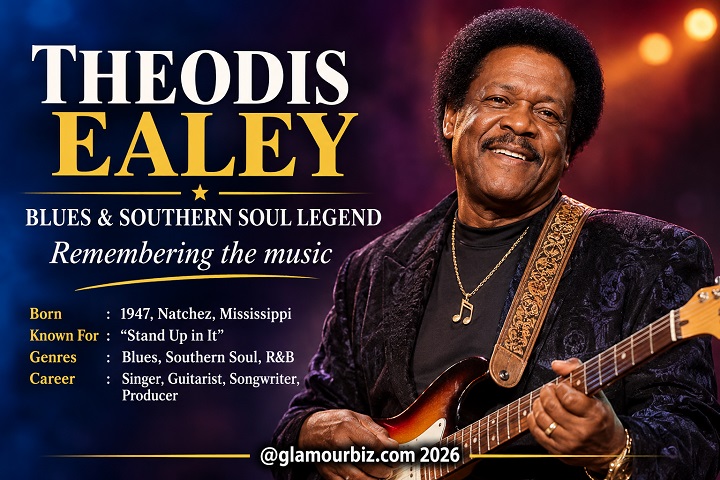
Theodis Ealey, the Southern soul and blues singer known as “the Bluesman Lover,” has died at 79, according to a post on the Mississippi Delta Blues Facebook page. Fans and fellow musicians have been sharing tributes online. No family statement or formal obituary has been found, and no cause of death has been reported.
Born in 1947 in Natchez, Mississippi, Ealey grew up in a musical family of eleven children. He began playing as a boy and was performing in his early teens with his brothers YZ and Melwin in YZ Ealey and the Merry Makers. After six years in the U.S. Air Force, stationed in Hawaii, he spent time in Oakland, California, and settled in Atlanta in the early 1990s.
In Atlanta he played guitar behind artists such as Little Milton and Charles Brown, then built his own career, signing with Ichiban Records in 1991 and later releasing music on his own IFGAM Records label. His best-known song is “Stand Up in It.” He won the Mo’ Better Blues Male Artist of the Year award in 1997 and toured the United States and Europe, playing festivals including the Chicago Blues Festival.
Blues Singer Theodis Ealey, the "Bluesman Lover," Dies at 79; Cause Not Yet Reported
Word has spread through the Southern soul and blues community that Theodis Ealey has died at 79. The news first surfaced in a post on the Mississippi Delta Blues Facebook page, and fans and fellow musicians have been sharing memories ever since. At the time of writing, no family statement or formal obituary has been found, and no cause of death has been reported. Anyone planning to share this story should wait for confirmation from his family or his band before treating the details as settled.
What is not in doubt is the size of the space he leaves behind. For decades, Ealey carried the nickname "the Bluesman Lover," and he earned it the honest way, one crowded room at a time. He sang about love, heartache, and mischief with a warmth that made people feel he was talking to them personally. Many listeners will remember him best for "Stand Up in It," a song that turned up at juke joints, dance floors and festival tents for years and became his calling card.
There is a particular kind of sadness when a working musician dies. These are not always people with giant mainstream fame. They are the ones who played the late set, signed the CD at the merch table, and remembered your name the second time you came back. Ealey was that kind of artist. His career was built on showing up, and the tributes that are starting to appear online suggest how many people he showed up for.
Born in Natchez, Heard Around the World: The Story of Theodis Ealey
Theodis Ealey was born in 1947 in Natchez, Mississippi, into a family where music was part of daily life. He was one of eleven children, and several of his brothers would go on to make records of their own. The Ealey family from the Sibley area is remembered as one of the most gifted musical families the Natchez region ever produced, and the Mississippi Blues Trail recognizes the brothers with a marker.
His first lessons came early. His older brother YZ showed him how to play an instrument when Theodis was only about four years old. By his early teens he was on stage. He played bass in a band led by YZ and another brother, Melwin, called YZ Ealey and the Merry Makers, and the trio's debut came at a Natchez nightclub known as the Horseshoe Circle. A year or so later he moved from bass to guitar, the instrument that would define his sound.
Growing up in that part of Mississippi in the 1950s and 1960s meant hearing the blues everywhere. Ealey has talked about how much a local juke joint shaped his love for the music, and you can hear that education in the way he performed later. He never sounded like a man reading from a script. He sounded like someone who had learned the blues by watching real people live it on a Saturday night.
The Ealey name carried weight at home long after he left. Natchez newspapers kept covering his visits, and in later years he and YZ played together at events celebrating their family. The brothers were also inducted into the Delta Music Museum Hall of Fame, an honor that recognized not just one singer but a whole family's contribution to the region's music. Seeing Theodis and YZ share a stage in Ferriday, with a crowd on its feet, was a reminder that the music had stayed close to home even as his career traveled far.
Air Force Veteran, Atlanta Bandleader, Southern Soul Star: The Career of Theodis Ealey
Like plenty of young men from small Southern towns, Ealey wanted to see more of the world. The U.S. Air Force gave him the chance. He spent six years stationed in Hawaii, a long way from the Mississippi River, and then settled for a while in Oakland, California. The Bay Area was where his talent started to get noticed outside the South. In 1994 he picked up a Male Vocalist Top Star Award there, an early sign that audiences far from Natchez were paying attention.
In the early 1990s he made Atlanta his permanent home, and the city became the base for everything that followed. Before he was a headliner, he was a sideman and a good one. He played guitar behind respected names including Little Milton, Johnny Clyde Copeland, Richard "Dimples" Fields and the legendary Charles Brown. He even worked with the Blues Brothers. That apprenticeship mattered. Backing great singers teaches a guitarist when to speak and when to leave space, and Ealey carried that discipline into his own records.
His recording career took off in the early 1990s with the Atlanta-based Ichiban Records, which signed him in 1991. Over the following years he put out a run of albums that built his reputation, including a self-titled debut, "Love Is a Gamble," and "Stand Up in It." In 1997 he received the Mo' Better Blues Male Artist of the Year award. He also showed a willingness to cross genre lines, appearing as a featured vocalist on a record by the hip-hop group Ghetto Mafia, which brought some of their listeners to his music.
Later on, he took control of his own catalog. He released music on his IFGAM Records label, including the 2009 album "Live," which featured Latimore as a guest. Over the years he also appeared on Jus' Blues Records releases. In 2008 he was honored with an achievement award at the Jus' Blues Music Awards, a nod from the community that knew his work best.
It is worth saying plainly that Ealey blended styles in a way that was hard to label. His shows leaned on traditional blues, but they also carried funk, soul, country, and even a bit of rock. Some artists chase a lane. He seemed to ignore lanes completely, and that freedom is a big part of why his audience stayed loyal.
From a Family of 11 to Festival Stages in the U.S. and Europe: Theodis Ealey's Blues Legacy
Growing up as one of eleven kids teaches a person how to share a room, and Ealey seemed to carry that instinct onto the stage. He performed with brothers whenever he could. In 2009 he took his older brother David, known as Bubba, on a tour of Europe, and YZ was also invited to perform overseas with him. Of the four brothers who made records, David and Melwin passed away years ago, which makes the loss of Theodis hit the family circle especially hard.
His touring life was long and busy. He took his band on a world tour in 2002, and for years afterward his name appeared on festival posters across the United States. He played the Chicago Blues Festival, the Poconos Blues Festival, and a long list of Delta festivals. More recent bills, including the Motor City Blues Festival and a Chi-Town Blues Festival date, showed that he was still working and still drawing crowds well into his late seventies. His band, made up of experienced players who traveled with him around the globe, was known for a tight, lively show that ranged from small bars to large stages.
What made Ealey special on stage was how personal he kept things. Southern soul and blues audiences tend to be loyal and very vocal, and he knew how to talk to them. He joked, he teased, and he sang about relationships the way regular people actually live them. Fans often describe the feeling of a Theodis Ealey show as a party that also happens to be good music, and that is harder to pull off than it sounds.
His legacy is partly in the recordings and awards, but it also lives in the people he influenced and the audiences he kept connected to a style of music that does not always get radio attention. Southern soul and blues survive because artists like Ealey keep touring, keep recording, and keep treating small-town crowds with the same energy as big-city ones. Younger performers on the circuit owe something to that example.
For now, much of what is being said about him is coming from fans, friends, and fellow musicians, not from official channels, so details will likely become clearer in the days ahead. A family statement may eventually tell us more about his final days, his survivors, and how people can honor him. Until then, the best tribute may be the simplest one. Put on "Stand Up in It," turn it up, and let a Natchez-born bluesman do what he did best.