
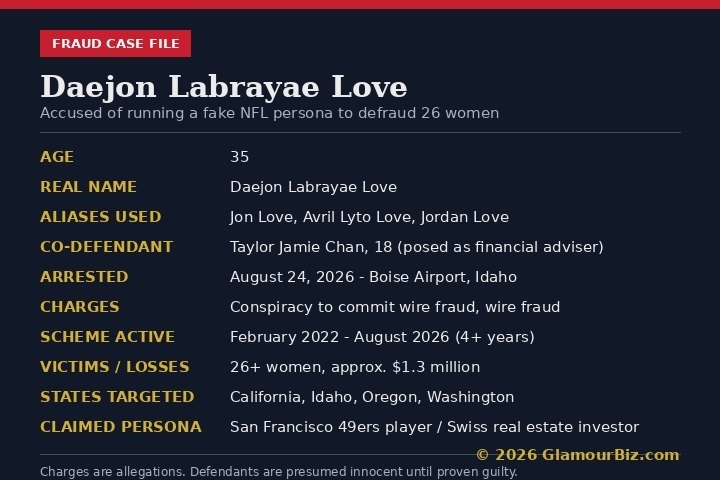
Daejon Love posed as a rising NFL talent tied to the 49ers for nearly three years, using fake gear, staged photos, doctored highlight reels, and fabricated documents to convince women he was a pro athlete (and even claimed ties to a wealthy Swiss family). The FBI arrested him in Boise, Idaho, on August 24, along with 18-year-old Taylor Jamie Chan, on wire fraud charges.
Love had name-dropped Tyreek Hill, Antonio Brown, and John Brown as close NFL friends in a viral clip. Hill responded with a joking TikTok calling Love his "bestie," while John Brown flatly denied ever meeting him, demanding proof. The case highlights how convincing and elaborate online romance scams can get when someone builds a fake identity around real, recognizable names.
Fake NFL Star Busted: FBI Arrests Man Behind Elaborate 49ers Persona
Daejon Love spent close to three years pretending to be someone he wasn't. Not in a small, harmless way either. On social media, and apparently in person with the women he targeted, he presented himself as a rising talent connected to the San Francisco 49ers. He never played a down in the NFL. Not one.
That all fell apart on August 24, when FBI agents picked him up in Boise, Idaho. He was reportedly still wearing 49ers gear at the time of the arrest, which honestly says a lot about how committed he was to the bit. He's now facing federal wire fraud charges, along with 18-year-old Taylor Jamie Chan, who was arrested alongside him and is accused of helping run the scheme.
Read the criminal complaint and you start to realize this wasn't some half-hearted lie he told a few people. He allegedly bought custom 49ers equipment, a helmet included, good enough to pass a quick glance from someone who wasn't looking too closely. There were photos of him posing with stacks of prop cash. Fake financial paperwork to back up stories about signing bonuses. He even put together doctored Instagram reels meant to look like highlights from different stages of a football career that never happened.
And it didn't stop at football. Investigators say he also claimed to come from a wealthy Swiss family and told people he had a side business in real estate, stacking one lie on top of another until the whole picture seemed believable. At one point he reportedly told a woman he was related to Green Bay Packers quarterback Jordan Love, banking on the shared last name to make an already shaky story sound more legitimate.
What sticks with you about this case isn't just how elaborate the lie was. It's how long he got away with it. Federal investigators say this went on from 2022 until his arrest this year. That's a lot of time to keep juggling fake documents, staged photos, and a story that had to stay consistent across dozens of relationships.
26 Women, $1.3 Million: The Anatomy of an Online Romance Scam
Here's where the story stops being just a weird headline and starts being genuinely upsetting. Investigators say around 26 women were pulled into this scheme, and between them they lost roughly $1.3 million. That's not one unlucky person. That's dozens of people, deceived over months or years, often believing they were in real relationships.
Romance scams tend to work the same way underneath, even when the costume changes. Trust gets built slowly. Weeks, sometimes months, before money ever comes up. In Love's case, the fake NFL career and the supposed family wealth did a lot of the heavy lifting. If someone believes they're talking to a pro athlete with real money behind him, they're a lot more likely to help him out with a loan, put money into a "business opportunity," or cover some short-term expense he swears he'll pay right back.
The complaint mentions he told at least one alleged victim that training with actual NFL players helped him land offers from different teams, eventually claiming the 49ers gave him the best deal. That specific kind of detail is usually what makes a scam land. It's not just "I'm rich and famous." It's a story with texture, names, and enough plausible detail that it doesn't fall apart the second someone asks a follow-up question.
It's worth saying plainly: this isn't about victims being naive. Scams like this one are built by people who put real time into the lie, buying props, faking documents, editing videos, and learning how to sound convincing. That takes effort. The people who fell for it were up against someone who treated deception like a full-time job.
Tyreek Hill Has the Perfect Response to Being Name-Dropped by an Alleged Con Artist
Once this story started making the rounds, one detail in particular blew up online. In a clip Love reportedly used to convince potential victims he was legit, he claimed three current NFL players were close friends of his: Tyreek Hill, Antonio Brown, and former Bills receiver John Brown.
That clip crossed two million views on X pretty fast, and it obviously reached the guys he was name-dropping. Hill's reaction ended up being the best part of the whole thing. Instead of firing off a serious denial, he just leaned into how ridiculous it all was. He posted a TikTok jokingly calling Love his "bestie," claiming they used to train together, even throwing in a bit about how fast Love supposedly was, all delivered with a clear wink.
He made it obvious he wasn't confirming anything real, poking fun at the beach clips tied to the scam and basically saying Love has a talent for making people believe things that aren't true. It was a smart way to handle it. Taking it seriously would've given the story more oxygen than it deserved. Making a joke out of it did the opposite, and it earned him some laughs along the way instead of headlines about him being caught up in a fraud case.
It's kind of a modern playbook for celebrities getting dragged into someone else's mess. No lawyer statement, no stiff denial. Just humor, and it worked.
'I Never Met You': NFL Player John Brown Publicly Denies Ties to Accused Scammer
Not everyone found it funny, though. John Brown went a different route entirely, posting on Facebook to flatly deny ever meeting Love. He didn't play along or make a joke out of it. He just said it straight: Never met you. Prove it if you can. Show me a photo or a text message.
That contrast between Brown and Hill is actually kind of interesting. Hill defused the situation with a joke. Brown shut it down with a hard no. Different tone, same goal, both of them putting distance between themselves and someone accused of running a serious fraud operation.
Brown's denial matters beyond just his own reputation, too. For the women who were scammed, and for anyone following this case, hearing a named player say flatly that there was no relationship at all confirms just how fabricated the whole thing was. This wasn't an exaggerated friendship or a loose acquaintance getting blown out of proportion. According to Brown, there was nothing there to begin with, which says a lot about how far Love was willing to stretch the truth just to make his story sound real.
As the case against Love and Chan works its way through the courts, these reactions from Hill and Brown end up being a strange little footnote to a much bigger story, one about how far someone will go to build a fake life and how easily that life can borrow credibility from names that were never actually involved.