
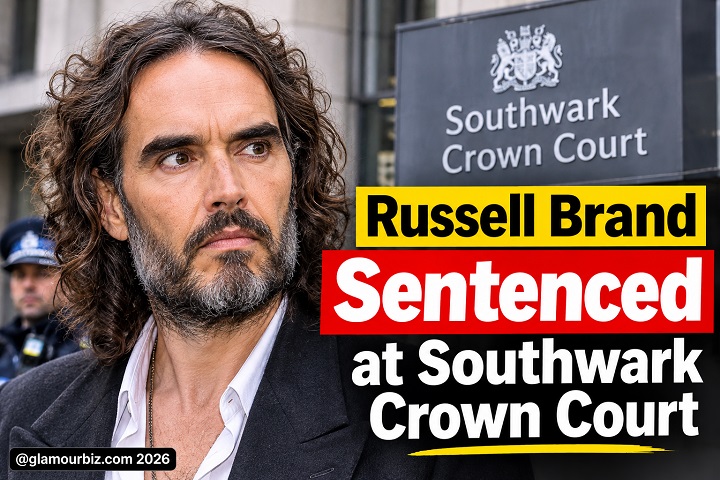
A London jury found Russell Brand guilty of one count of rape and three counts of s*xual assault on 5 November and cleared him of three other counts. On 9 November he was sentenced to ten and a half years in prison. Brand has denied all charges and has said he never had non-consensual s*x.
Russell Brand Is Sentenced to Ten and a Half Years After a Trial That Took Three Years to Arrive
A London jury convicted the comedian on four of seven counts. Here is how a story that began with a television documentary ended in a courtroom and what the court actually decided.
Few celebrity cases have been followed as closely in Britain this year as the trial of Russell Brand. For nearly a month at Southwark Crown Court, jurors heard evidence from six women, watched police interviews, and listened to Brand give evidence in his own defense. The outcome came in two stages, a verdict on 5 November and a sentence on 9 November, and each deserves careful reporting. What follows sticks to what the court found, what was said in open court, and what Brand himself has maintained.
Eight and a Half Hours of Deliberation, Then a Verdict That Split Seven Counts Into Four and Three
On Thursday 5 November, a jury of eight men and four women returned its verdicts after roughly eight and a half hours of deliberation. They found Brand guilty of one count of rape and three counts of s*xual assault. They cleared him of two further counts of rape and one count of indecent assault. The judge, Mr Justice Bennathan, had told jurors at the outset of their deliberations that he could only accept a verdict agreed by all twelve of them.
That split matters, and it is often lost in headlines. A guilty verdict on four counts and a not guilty verdict on three suggests a jury that examined each charge separately instead of delivering one verdict on a famous man. It is the sort of detail that tells readers the system worked as it is meant to work, with each allegation tested on its own evidence.
Once the verdicts were read, the judge refused bail on the basis that Brand was considered a flight risk. He had spent the trial arriving each morning with his wife, Laura, and he left the building in a police van. For a performer who once moved easily between British television and Hollywood, the contrast could hardly have been sharper. The court, however, was not dealing with a performer. It was dealing with a defendant, and the verdict addressed what the jury believed had happened to four of the women who gave evidence.
Six Women Whose Names the Public Never Heard, and the Seven Charges Their Accounts Built
The prosecution case rested on the accounts of six women, whose identities were protected throughout the trial. The brand faced three allegations of rape, three of s*xual assault, and one of indecent assault. The jury heard that the alleged incidents took place in a range of settings, including a hotel room, a luxury home in London, workplaces, and a bar toilet in Soho. One of the earliest allegations related to a meeting at a Labour Party conference in Bournemouth in 1999.
The jurors did not only hear live testimony. They also watched recorded police interviews with all six complainants, and they were shown several police interviews with Brand, in which he read from a prepared statement. Taken together, the material gave the panel a long and detailed picture of how the accounts had developed since the first public allegations. That documentary record is one reason the case ran for several weeks rather than a few days.
The path to this courtroom was not straight. Brand was first charged in April 2025 and pleaded not guilty a month later. The trial was originally set for the summer of 2026, but the court heard that finding jurors for the start of the school holidays would be difficult, and the judge also concluded that a case combining all seven charges could take around two months. The start moved to 12 October. Jury selection took two days; the prosecutor, Riel Karmy-Jones KC, opened the case on the Wednesday, and the jury retired in early November after about three weeks of argument and evidence.
A Documentary, a Newspaper Investigation, and Three Years Before the Case Reached a Courtroom
The story did not begin in a courtroom. In September 2023, a Channel 4 Dispatches documentary and reporting by The Sunday Times and The Times published allegations from several women. The Metropolitan Police opened an investigation soon afterward, and the BBC, Channel 4, and the production company Banijay all began their own internal reviews of their past dealings with Brand.
That sequence is worth pausing on, because it shows how slowly accountability can move and how much it depends on individual people being willing to speak. Reporting led to a police inquiry, the inquiry led to charges, and the charges led, three years after the first broadcast, to a jury. At every stage the process required women to describe events that had happened up to two decades earlier to investigators and then to strangers in a public court.
It also explains why the case sparked so much argument beyond the legal question. Brand’s lawyer, Ian Winter, told the jury about the devastating impact of the Dispatches program on his client. The prosecution, for its part, described the defense account as a collection of half-truths spun into lies. Neither description is a finding of fact, but both show how bitterly contested the central issues were and how heavily the documentary hung over the whole trial.
The Judge’s Words on Sentencing Day, When Four Complainants Spoke Before the Cells Closed
On Monday 9 November, Brand was sentenced to ten and a half years in prison. Before the judge spoke, four of the women who had brought the case read impact statements to the court. Brand’s wife and his father were in the room. NPR reported that he held a rosary and prayed as the proceedings unfolded.
The prosecution asked for a long sentence and pointed to aggravating factors in one of the offenses. The defence argued that Brand was a fundamentally different person from the man he had been when the offences took place. The judge was not persuaded to treat that as a reason for leniency. In his remarks, he said that Brand had become a s*xual predator, and he took a moment to pay tribute to the determination and bravery of the women who came forward. He then ordered Brand to be taken down to the cells.
The judge also placed the offenses in their time. About twenty years ago, he reminded the court, "Brand was becoming famous," and the Associated Press noted that the offenses happened when his bawdy behavior was indulged and celebrated during his rise to stardom. That observation has resonated beyond the courtroom, because it points at a wider culture. In the early 2000s, chaotic and boundary-pushing behavior was often treated as part of the act, and the people who benefited from it were not always asked hard questions. Plenty of former colleagues have since said they noticed unsettling conduct, and the entertainment industry has gone through a long and uneven period of reflection since 2017. This case is likely to remain part of that conversation.
What Brand Told the Jury, and Why Fair Reporting? Keeps His Denial on the Record
Brand has denied every charge from the start. When he gave evidence, he told the jury he knew what "no" meant, and he has consistently said that he never had non-consensual s*x. When he was charged in April 2025, he said he was grateful for the chance to defend himself in court. That chance has now been used, and the jury’s verdicts are the legal outcome.
Responsible coverage has to hold two things at once. On one side, a jury has convicted him of rape and s*xual assault, and a judge has passed a lengthy sentence. On the other side, Brand maintains his innocence, and the defense arguments he and his lawyers made form part of the public record. Presenting both honestly is not a way of softening the story. It is simply accurate, and it protects publishers from adding claims that no court has tested.
For readers, the wider point is about how these cases work. Brand’s public image changed enormously in recent years, from television comedian to political commentator and online personality, and he spoke openly about a conversion to Christianity. None of that was the question before the jury. The question was what happened to six women, and on four of the seven counts the jury decided that the answer was a crime.
What happens next is largely a matter for the lawyers and the courts. Any talk of appeals would be speculation at this stage, and it would be unfair to guess at outcomes. For the women who gave evidence, the verdict ends one long chapter. For Brand, the immediate future is a prison term of ten and a half years. And for the rest of us, the case is a reminder that justice can be slow, that it often depends on courage, and that the way we write about it should be accurate, careful, and humane.