
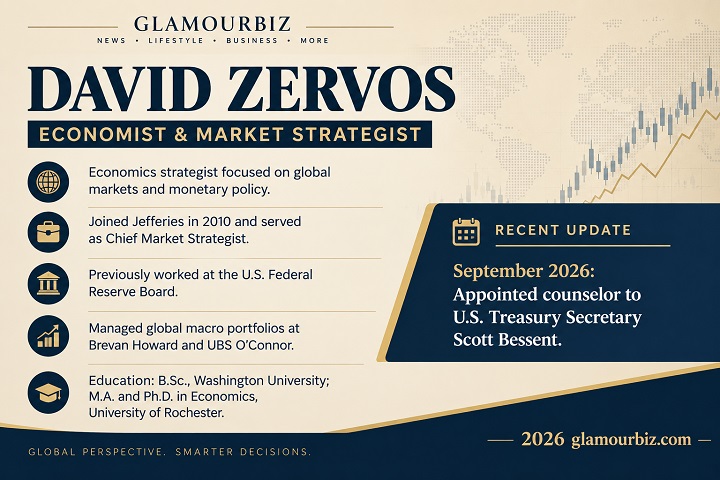
David Zervos, a longtime Wall Street strategist and CNBC regular, is heading to Washington. Treasury announced on September 28, 2026 that he will join Secretary Scott Bessent's office as a counselor, just as the department works to bring down rising long-term bond yields.
You can use the first one as the main opening and the second as a short summary near the top of the page or in a social media post. I can also write a "key highlights" box to go right after the intro if you want one.
From Jefferies Desk to Bessent's Inner Circle: Zervos Joins Treasury as Counselor
On Monday, September 28, 2026, the U.S. Treasury Department announced a new hire. David Zervos, a well-known Wall Street strategist, will serve as a counselor in the office of Treasury Secretary Scott Bessent. Job titles like "counselor" can sound vague, but the idea is simple. He'll be a senior person working close to the top, giving advice on economics and markets.
Zervos wasn't an obvious outsider. Most recently he was chief market strategist at Jefferies, and he has spent years talking about the economy on television as a CNBC contributor. So this isn't a case of an unknown academic walking into government. It's a familiar market voice moving from commenting on policy to working inside the department that helps shape it.
The timing matters too. Treasury is dealing with rising long-term borrowing costs and a lot of public worry about government debt. Bringing in someone with a market background and strong opinions about how the system should work sends a signal about how the department wants to handle the pressure.
Who Is David Zervos? A 35-Year-Market Veteran Steps Into Bessent's Office
Treasury's own announcement describes Zervos as someone with about 35 years of experience in global financial markets, central banking, and macroeconomic analysis. That's a long time to watch money move around the world. He has seen the market go through booms, scares, and plenty of arguments about what central banks should do.
Much of his working life was spent advising the people who manage very large sums of money. According to Treasury, his clients included money managers, banks, hedge funds, pension funds, and sovereign wealth funds. These are investors who can't afford to guess wrong about interest rates. A strategist in that seat has to take messy economic data and explain, in plain language, what it means for real decisions.
He has also been a public figure. Regular appearances on CNBC made him a familiar name to anyone who follows financial news. He isn't the type to hide behind vague statements, either. His opinions on the Federal Reserve are direct and easy to summarize.
Zervos believes the Fed's policy has become too tight. In his view, keeping interest rates high while holding the Fed's balance sheet small has held the economy back. He has said rates should come down toward a more neutral level, meaning one that neither pushes growth nor drags on it. He has also warned that keeping policy too restrictive can needlessly weaken demand and hurt the job market.
You don't have to agree with him to see why he's a notable pick. Whether a person thinks rates are too high or too low is one of the biggest debates in economics right now, and Zervos is clearly on one side of it.
From Jefferies to the Fed to Treasury: How Zervos Built a Career Around Markets and Monetary Policy
If you look at Zervos's résumé, you can see him looking at the financial system from several different angles. The first is the private sector. As chief market strategist at Jefferies, his job was to form views about where markets were heading and explain them to clients. Strategists in that role live in the world of trading, prices, and investor mood. They have to be practical, because their advice gets tested by the market almost immediately.
The second angle is the central bank. Zervos worked as an advisor in the Federal Reserve Board's Division of Monetary Affairs. That division deals with the nuts and bolts of monetary policy, so time spent there means seeing how interest rate decisions are prepared and debated. It's a different point of view from the trading floor. Instead of reacting to what the Fed does, you're part of the process that helps figure out what the Fed should do.
The third angle is the media. As a CNBC contributor, Zervos had to make complicated topics understandable to a general audience. That skill is more valuable than it sounds. Economic policy only works well when people understand what's going on, and explaining a tricky move clearly is half the battle.
Now he adds a fourth angle, the executive branch. Working in the Treasury secretary's office puts him among the people who decide how the government manages its debt and communicates with markets.
Put it all together, and the path makes sense. He went from the market to the central bank to the airwaves and now to the department that issues the government's debt. Each step gave him a different piece of the picture, and Treasury is clearly hoping that the full picture will be useful.
A Rate-Cut Advocate Enters Treasury: Zervos Brings Dovish Views and Buyback Backing to Bessent's Office
To understand why this hire is getting attention, you have to look at what Treasury has been doing lately. Long-term Treasury yields have jumped over the past several weeks. Investors have been worried about government borrowing and the direction of fiscal policy. When yields on long-dated bonds rise, borrowing gets more expensive across the economy, which is why so many people watch them closely.
Treasury's response has been to buy back some of its own older debt. The department said earlier this month that it would purchase up to $6 billion of older, longer-term bonds, after it had already approved $2 billion in buybacks in August. The focus is on 10-year and 20-year securities.
Bessent explained the reasoning at a September 8 event. Older bonds, which traders call "off-the-run," are harder to buy and sell than newly issued ones. Because they trade less easily, the gap between buying and selling prices gets wider, and investors are less eager to hold them. Treasury's answer is to step in and help make a market for those bonds.
There's a wrinkle, though. After the larger buyback plan was announced, yields went up instead of down. So the program hasn't produced the result many people expected, at least not yet.
Zervos has been a public supporter of the idea. Speaking to CNBC in August, he compared the buybacks to "operation twists," a tool the Fed has used before. In those operations, a central bank shifts its bond holdings to push longer-term rates lower. He noted that they've worked well when the Fed did them and that it's more unusual for Treasury to try it. Still, he said he didn't see how anyone could bet against it, since the Treasury Department holds so much of the power in this situation.
He also had a message for people worried about the size of the government's debt. He said some observers were getting overly anxious about the huge $40 trillion figure and about future spending, particularly related to the war. To him, the buybacks were a timely way to keep long-term yields from running away to the upside.
Not everyone is comfortable with this direction. Some experts are asking whether Treasury's bond market actions blur the line between two jobs that have traditionally been separate. The Fed handles monetary policy, while Treasury handles debt management. Banking experts have also pointed out that when the government steps into the market, it can be harder for the Fed to read what bond prices are saying about the economy.
That's the backdrop for Zervos's arrival. He comes in as an open supporter of both lower interest rates and the buyback strategy, and he'll now be advising the person leading it. Whether his ideas help calm the bond market or add to the debate over Treasury's role is something we'll find out in the coming months.