
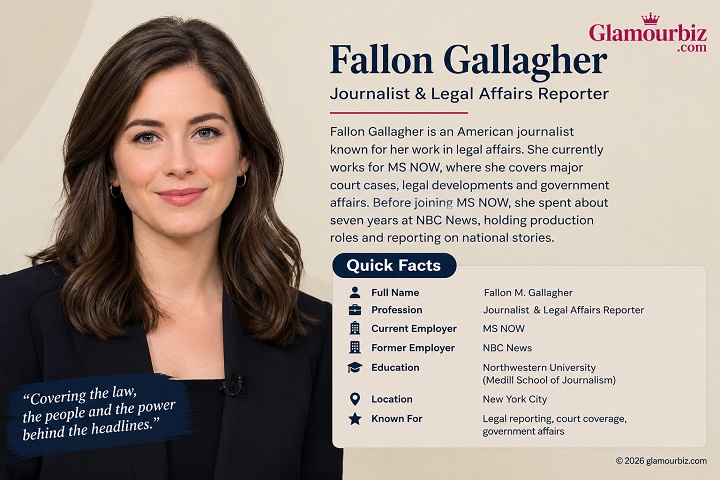
Most people know Fallon Gallagher from her legal coverage on MSNBC. But she didn't start in a courtroom. She started in a newsroom in Washington, D.C., working on whatever story came in that day, and it took several years and a lot of different assignments to get where she is now.
Her career is worth a look because it doesn't follow one straight line. She has covered politics, planes, school shootings, hurricanes, military defense, and a presidential trial. Here's how it all fits together.
From Washington Bureau to Legal Desk: The Rise of an Award-Winning Journalist
Gallagher began her career in NBC's Washington Bureau. If you're a young journalist, that's about as good a starting spot as you can get. You're a few minutes from the White House and Congress, and big stories land on your desk fast.
They landed on hers fast, too. Early on she worked on coverage of President Biden's inauguration and on the American withdrawal from Afghanistan. Anyone who followed the news in August 2021 remembers how chaotic and emotional that story was, and being part of a team covering it would be a lot for anyone just starting out.
She also spent time on the transportation beat, which meant following the investigation and recertification of the Boeing 737 MAX after two fatal crashes. It's the kind of assignment that sounds dry until you realize how much is riding on it. There were grieving families, angry regulators, and a company under pressure, and the answers were buried in technical reports. Reporters who cover that kind of story learn to read the fine print and keep asking questions when officials would rather move on. That habit turns out to be very useful in a courtroom.
She went to Northwestern University, which has one of the best-known journalism programs in the country. Today she's an award-winning legal affairs reporter for MSNBC, and it's clear the path there was built one assignment at a time.
Traveling the World with Lester Holt: A Producer's Journey from Uvalde to Alaska
Before she moved to the legal beat, Gallagher spent a good stretch of her career as a producer on "NBC Nightly News with Lester Holt." She started as his Associate Anchor Producer, which meant she wasn't just working behind a desk in New York. She traveled with him to the places where the news was happening.
Some of those places were hard to be in. She helped cover the school shooting in Uvalde, Texas, in May 2022, when a gunman killed 19 children and two teachers at Robb Elementary School. The story stayed in the headlines for months because the questions about the police response kept coming. Producing a story like that means thinking carefully about every interview and every shot. You're talking to people on the worst days of their lives, and you have to get the facts right while still treating them with respect.
Fallon Gallagher also traveled to Florida after Hurricane Ian in the fall of 2022. Storm coverage has its own set of problems. You have to figure out where you can safely stand, how to get a signal, and how to reach people who may have lost everything. It's tiring, messy work, and it doesn't leave much room for error.
Then there was a very different trip. Gallagher went to Alaska and reported exclusively on how NORAD operates, and why it's considered the first line of defense as threats from Russia and China grow. It's a rare look inside a part of national security that most people only hear about in passing.
After some time as Holt's associate producer, she moved into a broader role at Nightly News. There she covered how the war in Gaza was affecting Arab American voters in the battleground state of Michigan. She also told the stories of Republican women in Ohio who were campaigning to protect abortion access. Both stories put regular voters in front of the camera, and both showed that people's views on big political fights are often more complicated than the headlines suggest.
Spending years working alongside a veteran anchor has to teach you a lot. You see how someone prepares for a broadcast, how they handle breaking news, and how they stay calm when the plan falls apart an hour before air. It makes sense that this stretch of her career shaped the reporter she became.
Supreme Court to Trump Litigation: Inside Fallon Gallagher's Legal Beat
Legal reporting is harder than most people think. Court documents are long and full of jargon, and rulings can come out at any time of day. A reporter may only have a few minutes to read something dense and then explain it clearly on air to people who never went to law school.
Gallagher's beat covers three main areas. The first is the Supreme Court, where a single decision can affect millions of lives for decades. The second is litigation involving the Trump Administration, which has kept courts busy with lawsuits, appeals and emergency motions. The third is the broader group of high-profile civil and criminal cases that draw national attention.
What makes this job tricky is that speed and accuracy pull in opposite directions. Viewers want to know right now what a court decided. But one misread sentence in a ruling can turn into a wrong headline, and in legal news that mistake spreads quickly. Good legal reporters learn to move fast without cutting corners.
Her earlier jobs seem to help here. Producing for Nightly News taught her how to shape a story for television. Working in Washington taught her how government institutions actually operate. Legal reporting needs both, because you have to understand the process and also explain it in a way that makes sense to a general audience. Before joining MSNBC, she reported on legal news for NBC. That gave her time to learn the beat before taking on a bigger role at the network.
Inside the Courtroom: Reporting on Trump's Manhattan Trial and Sentencing
If there's one assignment that put Gallagher's name in front of a lot of people, it's probably her coverage of President Trump's criminal trial in Manhattan. She covered the case and reported from inside the courtroom during his sentencing.
Being inside the room matters because there were no cameras in it. The public couldn't watch the proceedings live, so people depended on the reporters who were sitting there. Those reporters described what was said, how people reacted, and what the atmosphere felt like. For a lot of viewers, that was the only way to know what happened.
It's not easy work. You sit for hours, take notes constantly and try to catch the moments that matter while everything else keeps moving. Then you have to turn all of it into a clear report without adding your own opinion. When the defendant is a president, every word gets picked apart by people on every side, so there's not much room for sloppy phrasing.
It was also a historic case. It was the first criminal trial of a U.S. president, so the reporters covering it knew they were documenting something that would be studied for years. For Gallagher, it also pulled together everything she'd done before. She needed the political knowledge she built in Washington, the storytelling instincts she picked up as a producer and the legal know-how she's developed on her current beat.