
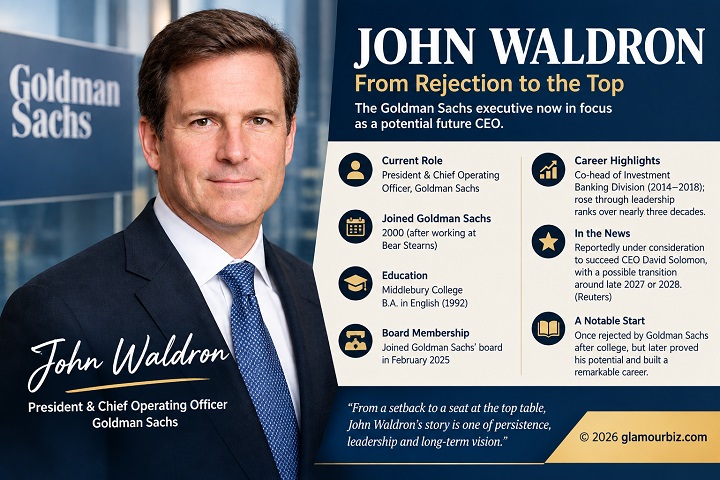
Reuters reported on September 28 that Goldman's board has discussed a plan for David Solomon to step down as CEO and hand the job to John Waldron, the bank's president and COO. The handover could happen around the end of 2027 or in 2028. Solomon would likely stay on as executive chairman for one to two years.
The plan still needs full board approval, which could come in the coming months. Goldman says there is no definitive timeline and that succession is something the board discusses regularly. Waldron has been widely seen as the heir apparent for years. He joined the board in early 2025 and received an $80 million retention award that runs through 2030. Reports also say he had been approached by Apollo and Carlyle, which is unconfirmed. Analysts expect him to keep Solomon's strategy, with a strong focus on AI through his OneGS 3.0 plan. The main risk is timing. Solomon may not be ready to leave, and Waldron may not want to wait forever.
Career: From Leveraged Finance to Goldman's Number Two
John Waldron did not appear at the top of Goldman Sachs overnight. He spent more than two decades moving up one job at a time, and the list of roles shows how patient that climb was. He grew up in Cleveland, Ohio, and his family moved to Philadelphia when he was 15. He went to Middlebury College in Vermont, where he studied English and graduated in 1992. That is a slightly unusual background for a Wall Street executive, since most people at his level come out of finance or economics programs. His early career included a stretch at Bear Stearns, the same firm where David Solomon, his current boss, also worked early on.
Waldron joined Goldman in 2000. By 2001 he was a managing director, and by 2002 he was a partner. That is a fast run at a firm where partnership is hard to earn. From there he moved through several parts of the investment bank. He co-headed the media and entertainment group, then leveraged finance, then the financial sponsors group, which deals with private equity clients. Those are demanding jobs, and they gave him a close view of how the firm makes money from its biggest clients.
In 2009 he took over global client coverage in investment banking. A few years later, in 2014, he became co-head of the entire investment banking division. He held that role until 2018.
That year, Lloyd Blankfein was getting ready to retire, and Solomon was set to become CEO. Solomon picked Waldron as president and chief operating officer. It was a notable choice. The president's job at Goldman had often been split between two executives, and Solomon chose to give it to one person. Waldron started in the role in October 2018 and has held it ever since. Colleagues have described him as having a softer style than Solomon, who is known as a demanding boss.
Along the way he has picked up plenty of side duties. He co-chairs the firm's enterprise risk committee, sits on outside boards including the Cleveland Clinic and Lincoln Center, and chairs the international advisory board of the Atlantic Council. He is also a trustee at Middlebury and Southern Methodist University.
From Deal-Maker to AI Architect: Waldron's OneGS 3.0 Bet
For most of his career, Waldron was known as a dealmaker. He knew clients, he knew how to win mandates, and he ran teams that did that work. As chief operating officer, the job changed. It is less about closing a single deal and more about how the whole machine runs.
The best example is a project called OneGS 3.0. It is a long-term plan, introduced in late 2025, that uses artificial intelligence to change how Goldman operates internally. The basic idea is to make the firm more efficient so that the same people can handle more work and so that the systems behind the scenes run faster and with fewer mistakes. Waldron is the executive most closely tied to it.
If you have never worked at a big bank, it helps to picture how much of the business is not glamorous. There are thousands of processes for onboarding clients, checking documents, managing risk, and keeping regulators satisfied. Every one of those costs time and money. A plan that improves even a few of them can matter a lot over a year.
There is one twist worth knowing. The Wall Street Journal reported that over the past year Goldman has moved some of Waldron's COO duties to its chief financial officer, Denis Coleman. Those reportedly include managing internal personnel and parts of the OneGS 3.0 work. That is a common step when a company is preparing someone for a bigger job. If Waldron does become CEO, he would have less day-to-day operating work to hand off, because it would already be in other hands.
Analysts also say he is not likely to change the strategy that Solomon built. The two men have driven the firm's priorities together since 2018. So if Waldron does take over, expect more of the same direction, with an even bigger push on technology, rather than a sharp turn.
He has also spoken publicly about newer areas of finance. Back in 2021 he said more clients wanted exposure to Bitcoin, and that Goldman was looking for a compliant way to serve them. His more recent interviews have focused more on AI than crypto.
The $80 Million Heir Apparent: How Goldman Reportedly Locked In Waldron
Ask anyone who follows Wall Street who will run Goldman next, and Waldron's name comes up first. It has been that way for years. But being the favorite is different from having the job, and Goldman seems to know it. In January 2025, the bank disclosed that it had given Waldron an $80 million retention award. It came in the form of restricted stock, and it only pays out if he stays for five years, which takes it through 2030. Solomon received a similar award. The message was simple: the board wanted both men to stay.
Why would a bank spend that much to keep an executive who already has a very high salary? Because losing him could be costly. CNBC has reported that Waldron had been in discussions for leadership roles at the alternative asset managers Apollo and Carlyle. That detail comes from reports, not from the companies, so it should be treated as unconfirmed. Still, it fits a pattern. Talented Wall Street executives are often approached by private equity and asset management firms, which can pay very well and offer top jobs sooner.
A month after the retention award, in February 2025, Goldman added Waldron to its board of directors. That is rare for anyone other than the CEO. Analysts saw it as a strong signal that the board was preparing for a handover.
Now there is fresh news. On September 28, 2026, the Wall Street Journal reported that Goldman's board has discussed a plan for Solomon to step down as CEO and for Waldron to take over. The timing mentioned was around the end of 2027 or sometime in 2028. Under the reported plan, Solomon would likely stay on as executive chairman for one to two years. The report also said the plan needs approval from the full board, which could come in the coming months.
Goldman did not confirm a schedule. A spokesman said there is no definitive timeline for succession, and the bank told Bloomberg that succession is something the board talks about regularly. So this is a report about discussions, not an official announcement.
There are real questions about how smoothly it could go. Solomon is 64, and CNBC noted that he may not want to leave while the AI boom is still in its early stages. If he stays too long, Waldron might grow tired of waiting. On the other hand, Wells Fargo analyst Mike Mayo described the possible handover as one of the smoother and more deliberate ones seen on Wall Street. Bloomberg's view was that the CEO change itself may be the easy part. The harder part could be the jockeying among senior bankers below him, who will want influence in the new setup.
Family: Married with Six Children, Behind One of Wall Street's Biggest Jobs
Running a bank like Goldman means long hours, constant travel, and very little time that feels like your own. So it is natural to wonder what life looks like behind the title. The public record here is thin, and that is probably how Waldron likes it. Reuters reports that he is married and has six children. That is about all that has been published in the sources I found. His wife's name is not given in that coverage, and I would not guess at more.
Six kids is a lot for anyone. For a person with a schedule like his, it says something about how much has to be juggled. It also fits with the community roles he has taken on outside the bank. He serves on the board of the Cleveland Clinic, which connects back to his hometown, and he sits on the boards of arts and education groups, including Lincoln Center and two colleges.
It is fair to be careful when writing about the private side of a business leader. Public figures accept scrutiny of their work. Their families did not sign up for the same thing. In a story like this one, the more useful takeaway is simple. The person who may soon lead one of the world's most powerful banks is also, by most accounts, a family man with a very full household.